
Loading...

Code Neptune builds on demand applications connecting customers, providers, delivery partners, and operators through booking, dispatch, tracking, payments, and communication, backed by proven Mobile App Development Company expertise.


The platform connects customers, service providers, operators, delivery teams, and administrators through one coordinated system, so every role gets the tools specific to what they actually do.

Discovery, booking, ordering, scheduling, payments, notifications, and service tracking.

Provider onboarding, availability, service requests, bookings, earnings, communication, and task management.

Dispatch management, assignment, scheduling, real-time status, location tracking, and operational coordination.

Mobile apps, backend systems, dashboards, APIs, payments, analytics, and third-party integrations.
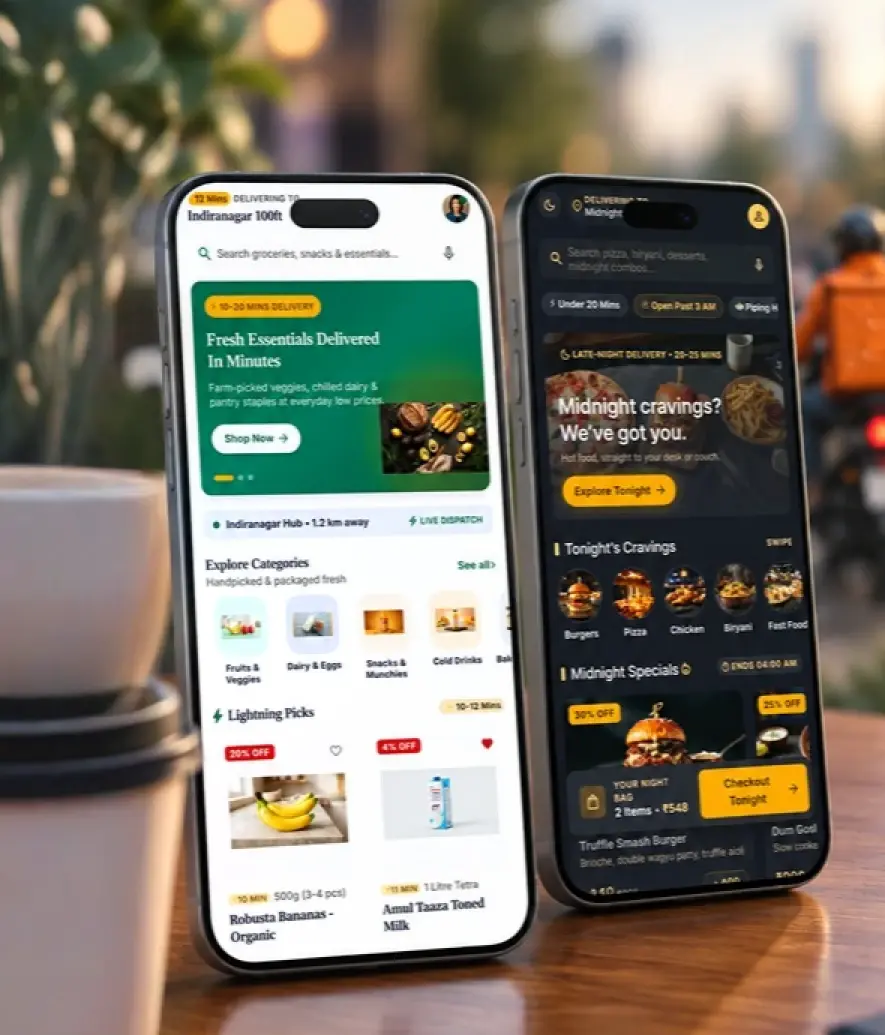
On demand platforms only work when every side of the transaction is accounted for. We build the customer app, the provider app, the operations dashboard, and the payment and dispatch logic that connects all three, so bookings move from request to fulfillment without manual follow up.
Customer booking, service discovery, provider assignment, scheduling, payments, notifications, and post-service reviews, built around how your specific service is actually delivered.

Order management, delivery assignment, driver tracking, dispatch logic, proof of delivery, and real time customer updates, tuned for the volume and delivery windows your business runs on.

Connect customers with independent providers through searchable listings, availability, bookings, payments, ratings, and the operational workflows that keep a two sided marketplace balanced.

Connected applications for businesses managing customers, providers, dispatch, reporting, and fulfillment across multiple teams, locations, or service lines from one operational layer.

Support ride booking, driver matching, location tracking, trip management, payments, notifications, and operational coordination.

Connect patients with healthcare providers and support appointment scheduling, service requests, communication, notifications, and relevant operational workflows.

Create connected systems for businesses managing customers, providers, employees, service requests, operations, payments, and multiple locations.

Develop scalable platforms that allow businesses to manage multiple services, providers, customers, locations, workflows, and operational dashboards from a connected system.

A customer app alone doesn't make an on demand business run. It needs a provider experience, an operations dashboard, payment and notification infrastructure, and a backend built to handle real time load. Our mobile app development services cover the full picture, not just the front end customers see.

We map customer journeys, provider workflows, booking logic, dispatch requirements, and business rules before writing a line of code, so the build reflects how your service actually operates, not a generic template.
We build customer and provider applications around your specific booking, ordering, scheduling, delivery, or marketplace logic, drawing on our broader custom mobile app development experience across service categories.
For businesses running multiple locations, provider networks, or operational teams, we build the applications and supporting systems that hold up under scale, drawing on our enterprise app development services work across larger operational builds.
We build connected experiences for customers, providers, drivers, and operations teams across the platforms your product actually needs, balancing performance and maintenance cost rather than building everywhere by default.
Payment gateways, maps and location services, notification systems, CRM and ERP connections, analytics, and third party APIs get wired into the platform so operational data flows in one direction, not five spreadsheets.
For platforms already live, we work on architecture upgrades, performance fixes, security improvements, new integrations, and workflow changes as the business evolves past its first version.
Share your customer journey, provider workflow, and growth goals so we can shape a practical product roadmap together.

On demand platforms process customer profiles, live location data, payments, provider records, and operational data at once. The right controls depend on what your app collects and where it operates, not a generic checklist.
Access controls and data handling practices scoped to what customer and provider information the app actually needs to function.
Controlled access and privacy aware handling for location data used in dispatch, delivery, or live tracking.
Payment provider integrations and application level controls that limit unnecessary exposure of transaction details.
Compliance requirements should map to the specific data, users, transactions, and markets your platform actually supports.
Separate permissions between customers, providers, drivers, operations staff, and administrators based on what each role actually needs to see or do.
Authentication, session handling, and access controls scoped to customer, provider, driver, and admin accounts differently.
Controlled access to GPS and location data used for provider matching, dispatch, and delivery tracking.
Protected communication between the mobile apps, backend services, payment systems, maps, and third party APIs.
Secure integration patterns around payments, bookings, orders, refunds, and other transaction workflows.
Booking, search, tracking, and notification workflows tuned for consistency under real world load, drawing on our approach to
Activity records, system monitoring, and error visibility that support troubleshooting without slowing the platform down.

On demand products have two sides of a marketplace to plan for at once. Getting the customer experience right doesn't matter much if the provider workflow behind it is broken.
We work through your customers, providers, fulfillment model, booking flow, operational rules, and service level expectations before scoping anything.
We prioritize the customer, provider, and admin workflows that matter for a first release, applying what we've learned from across other on demand builds.
We design clear, separate experiences for customers, providers, drivers, and operators, keeping booking status and communication easy to follow on every side.
Mobile apps, backend services, APIs, dashboards, integrations, and payments get built in structured, reviewable cycles rather than one long build.
We validate booking, provider assignment, location accuracy, payments, notifications, and performance under realistic conditions before launch.
Applications and backend systems get prepared for production, integrations get completed, and infrastructure gets configured to support the initial rollout.
Operational data and user behavior guide what gets improved or expanded next, following the same approach we use across our mobile work.

Bring your service model, customer journey, provider workflow, fulfillment process, and growth plans to a structured discussion so we can define the right product architecture.
Service discovery, booking, provider assignment, scheduling, dispatch, and order status handled as one connected workflow.
Cost depends on the number of applications, user roles, booking complexity, real time tracking, payments, integrations, and expected scale, not a flat per app rate.
3–5 months
Cost also depends on how the platform handles growth over time. For a deeper breakdown of what drives pricing up or down, our guide on app development cost covers it in more detail.
The right technology stack depends on your service model, number of user roles, real time requirements, and expected scale. Businesses researching which team qualifies as the best mobile app company for this kind of build, including options based in a mobile app development company in India, should weigh this against generic agency claims. .
Does the team understand customer booking, provider assignment, dispatch, and payments as one connected system, or just the front end screens?
Look for experience designing separate, connected experiences for customers, providers, drivers, and administrators.
Check for real experience with GPS, maps, live status, tracking, and dispatch, not just a claim that they've "done maps before."
Payment services, CRM, ERP, communication platforms, and analytics all need to connect cleanly. Ask what they've actually integrated before.
The platform should hold up as customers, providers, transactions, and locations grow, without a rebuild every time usage doubles.
Authentication, data protection, monitoring, and testing practices matter more once real payment and location data is involved.
A capable partner helps you prioritize the workflows that matter for launch instead of padding scope before the business model is even validated.
Clarify source code ownership, documentation, and technical handover up front. It's worth checking how a firm compares against other mobile app development companies on this specific point before signing anything.
Be cautious of vendors offering generic on demand templates without a real grasp of customer-provider workflows, dispatch logic, real time location, or long term scalability. That gap tends to show up after launch, not before.
Got Questions ?
We have the answers. Explore everything you need to know about Code Neptune’s services, process, and technology.
It typically includes customer apps, provider apps, delivery or driver applications, marketplace platforms, operational dashboards, backend systems, and the integrations that connect them.
Yes. On demand platforms typically need separate experiences for customers, providers, drivers, and administrators, connected through shared backend services and APIs.
Yes. Payment gateway integrations support booking, ordering, transaction, and refund workflows while keeping payment processing within appropriate security boundaries.
Yes. An MVP prioritizes the essential customer, provider, and booking workflows needed to validate the service model before expanding further.
Cost depends on user roles, booking and fulfillment workflows, real time tracking, payments, integrations, and expected scale. A structured discovery process establishes the actual scope before pricing.
Yes. GPS, maps, live status updates, and delivery or provider tracking can be built in based on what the operational model actually requires.
Yes. Marketplace applications connect customers with multiple providers through service discovery, availability, bookings, payments, and ratings.
A focused MVP can take several months, while multi-role platforms with real time tracking, payments, and complex operational workflows generally take longer.
Tell us how your customers and providers should connect, and we will help shape the right product architecture and roadmap.
01
Let us know everything you want to achieve!
02
A quick, no-pressure call to understand your needs.
03
Enjoy transparent pricing with potential discounts!
Enquiry
Careers
+91 98416 00980Visit
No. 624, 3rd Floor – S2, Khivraj Building, Anna Salai, Chennai – 600 006


No. 624, 3rd Floor – S2, Khivraj Building, Anna Salai, Chennai – 600 006
Jobs :
careers@codeneptune.comEnquiry :
info@codeneptune.com