
Loading...

Public services increasingly run through digital channels; applications, requests, payments, notifications, records move through connected platforms rather than paper or in-person counters. Code Neptune builds government applications linking citizens, staff, field officers, and administrative systems, using the same mobile app development services we apply across regulated, high-trust industries.






Connected experiences for citizens, government employees, field officers, departments, and public-sector administrators, built as one system rather than separate tools.

Applications, requests, appointments, certificates, notifications, and service tracking in one place.

Field reporting, task management, inspections, approvals, and internal communication.

Mobile apps, citizen portals, administrative dashboards, APIs, and backend systems working together.

Identity, permissions, data protection, audit trails, and controlled access across every workflow.
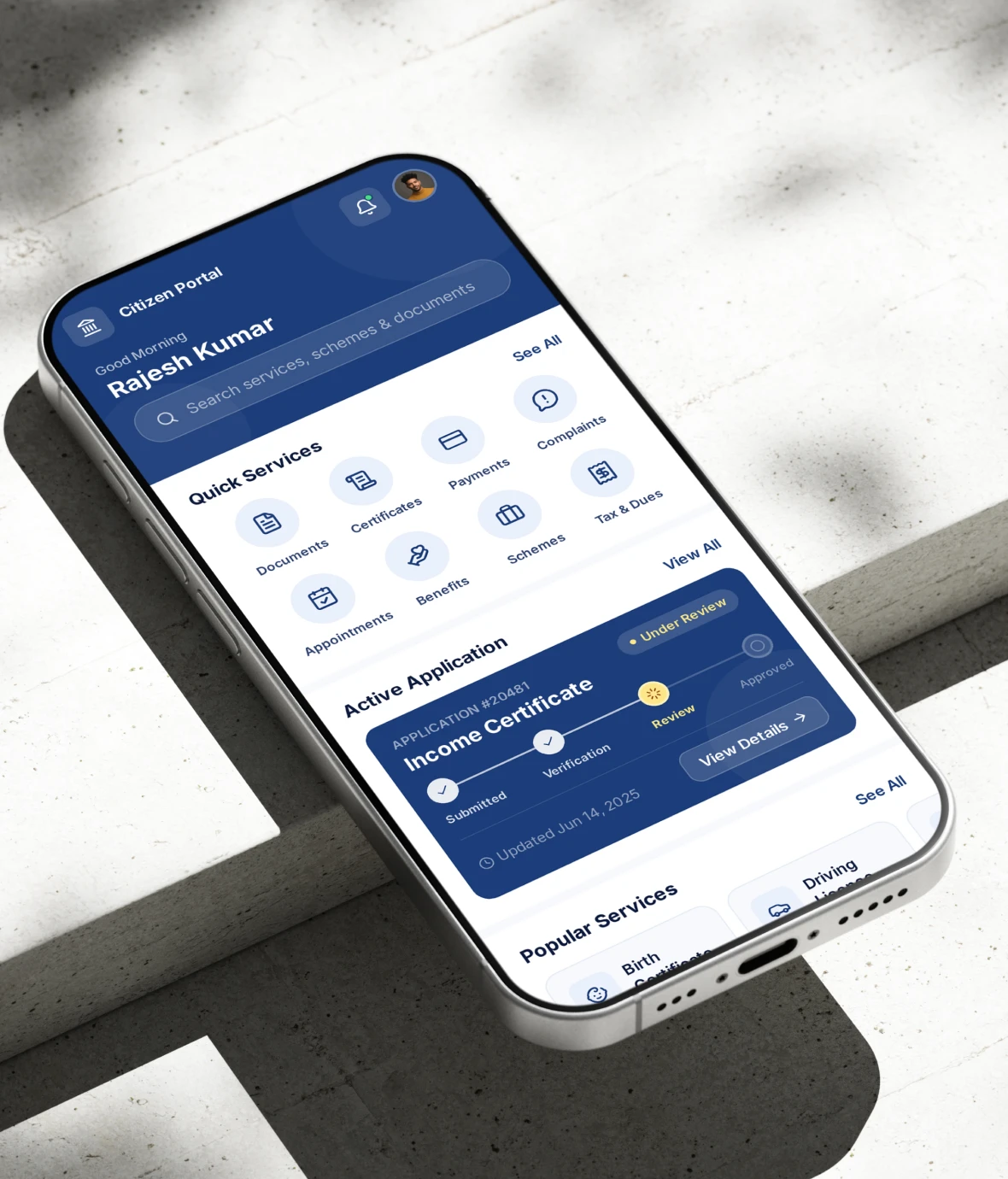
A government application rarely stands alone. Mobile experiences usually need to connect with citizen portals, identity services, payment platforms, administrative dashboards, and existing enterprise infrastructure, which changes how the project should be scoped from day one.

Citizen journeys, department processes, field operations, approval workflows, service requirements, accessibility considerations, and technology dependencies get mapped before scope is defined.
Purpose-built mobile applications for citizens, government employees, field officers, departments, and public-service organizations, developed through Code Neptune's custom mobile app development process across the platforms the project actually requires.
Connected applications and administrative systems supporting departmental workflows, role management, approvals, reporting, document handling, and integration with existing enterprise app development environments. Enterprise app development services in this context mean building for departments with multiple roles and approval chains, not a single-user app.
Native or cross-platform implementation, chosen according to device requirements, accessibility, performance, maintenance needs, and the operational environment of the application. For a citizen-facing app used across a wide range of devices, cross platform app development often gets the service live faster; for a field-officer app relying on device-level features like camera or GPS, native app development on Android application development or iOS gives more control. Code Neptune builds both, and recommends the stack based on the workflow rather than a fixed preference.
Government applications connected with APIs, identity systems, payment services, document platforms, databases, enterprise applications, notification services, and administrative systems already in use.
Legacy public-sector applications modernized with better usability and performance, added mobile capability, stronger integrations, and continued support after launch.
Government technology serves different users doing different jobs. A citizen checking an application status has different needs than a field officer filing an inspection report or a department head reviewing approvals. Each solution below reflects how public services are actually delivered rather than a generic feature list.
Mobile access to government services, applications, requests, notifications, appointments, and service status.

Departments, workflows, approvals, records, and administrative processes connected through one system.

Task management, reporting, inspections, attendance, communication, and location-based work for field officers.

Announcements, alerts, service updates, emergency information, and department communications across mobile and web.

Application submissions, document workflows, approvals, status tracking, and notifications, digitized end to end.

Complaints, civic requests, local services, payments, appointments, and issue reporting for city and local bodies.

Secure payment workflows for eligible services, fees, applications, licenses, and other transactions.

Operational data connected to dashboards, reports, service monitoring, and management insight.

Bring the existing workflow, citizen journey, departmental requirements, integrations, security expectations, and long-term product goals to a structured discussion before development starts.

Public-sector applications often handle sensitive citizen information, administrative records, payments, documents, and operational data. The architecture needs access controls, data protection, auditability, and governance built in rather than added afterward.
Data handling, access controls, retention considerations, and privacy-aware architecture matched to the project's jurisdiction and requirements.
Controlled authentication and role-based permissions separating access across citizens, employees, administrators, departments, and other authorized users.
Logging, activity tracking, approvals, and operational records designed for visibility across government workflows.
Compliance requirements should be mapped to the actual jurisdiction, application scope, data types, and procurement requirements rather than treated as generic checklist items.
Separate permissions for citizens, government employees, field officers, department administrators, and other authorized roles.
Account access protected with authentication workflows matched to the application's users, services, and security requirements.
Citizen information, documents, service records, and administrative data protected through application and infrastructure controls.
Communication secured between mobile applications, government systems, databases, identity services, payment platforms, and third-party APIs.
Visibility maintained into application activities, administrative actions, workflow changes, and access events.
Application behavior validated under realistic user loads and operational conditions, with performance bottlenecks identified before deployment.
Scalable infrastructure designed with controlled access, protected services, monitoring, backups, and deployment practices appropriate to the application.
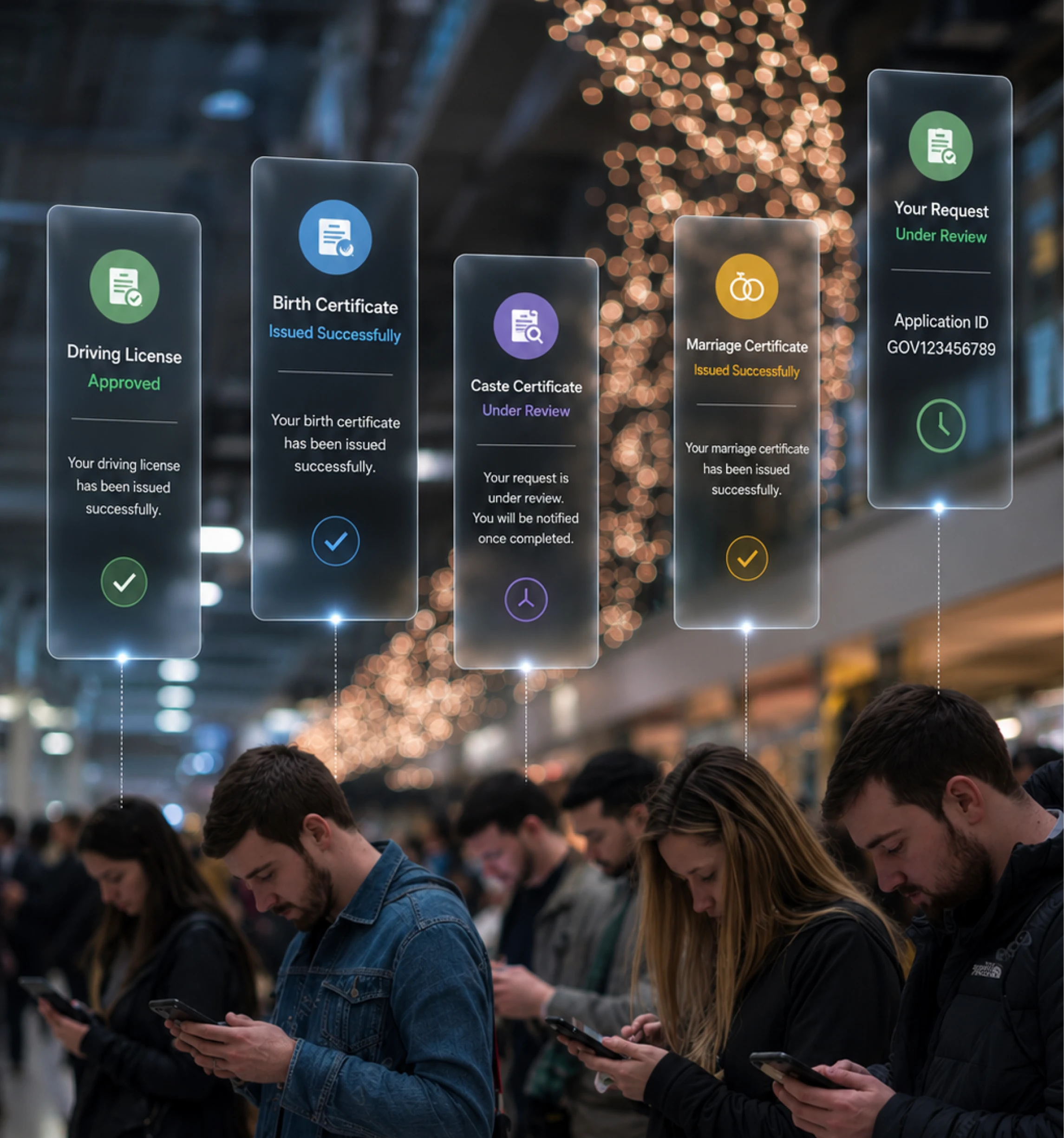
A public-sector application needs more than a development sprint. The process has to account for service workflows, multiple user groups, integrations, security requirements, accessibility, testing, deployment, and long-term maintenance.
Understanding the public service, users, departments, operational challenges, existing systems, and project objectives.
Requirements translated into a practical product scope, core services prioritized, an MVP defined where appropriate, and a technical roadmap established.
Clear experiences designed for citizens, employees, administrators, and field users, with accessibility, usability, multilingual requirements, and device conditions in mind, following the same approach used across other Code Neptune projects.
Mobile, web, backend, APIs, dashboards, integrations, and supporting services developed according to the approved architecture.
Functionality, integrations, accessibility, security, performance, permissions, and real-world service workflows validated before launch.
The application prepared for deployment and connected with the required government systems, services, APIs, infrastructure, and operational environments.
Performance monitored, operational feedback incorporated, services improved, security strengthened, and functionality expanded as government requirements change, following the same Code Neptune applies to every long-running product.

Bring the citizen journey, departmental workflow, technical requirements, and integration challenges to a structured product discussion.
Applications, requests, approvals, appointments, documents, notifications, payments, and service processes managed through structured business logic.
Government application costs depend on the number of services, user groups, integrations, security requirements, accessibility needs, administrative workflows, platforms, and long-term operational requirements.
3–5 months
Suitable for a focused citizen service, departmental application, or initial digital government product.
For government platforms requiring specialized workflows, procurement requirements, integrations, infrastructure, or phased enterprise development.
Timelines are indicative, not guaranteed delivery periods. Final scope and timeline are determined through discovery and technical assessment.
The most suitable technology stack should be selected according to the application's users, security requirements, integrations, accessibility needs, procurement conditions, and long-term maintenance strategy rather than choosing a framework because it happens to be popular. .
A team capable of translating departmental and citizen-service processes into practical digital workflows.
Government services often need citizen mobile apps alongside web portals and administrative interfaces; among mobile app development companies, look for one that has actually shipped both.
Experience connecting applications with existing databases, enterprise systems, APIs, identity platforms, and operational software.
A structured approach to access control, data protection, security testing, and operational monitoring.
Public applications designed for diverse users, devices, accessibility needs, and digital literacy levels.
A platform that can accommodate growing users, additional government services, new integrations, and expanding operational requirements.
Government platforms can operate for years, which makes maintenance, security updates, performance improvements, and feature evolution important considerations.
Clear ownership, documentation, deployment access, technical handover, and long-term control of the developed platform.
Be cautious of providers that offer generic mobile templates without understanding government workflows, accessibility, security, enterprise integrations, data governance, or long-term public-service operations. Code Neptune's own team, including mobile app developers based in Chennai, works through the same discovery process regardless of client location.
Got Questions ?
We have the answers. Explore everything you need to know about Code Neptune’s services, process, and technology.
A Government App Development Company can build citizen service applications, employee mobility solutions, municipal platforms, permit and application systems, public information apps, payment-enabled services, administrative dashboards, and connected government platforms.
Yes. Government applications can be developed for iOS and Android using native or cross-platform approaches. The right choice depends on performance requirements, device coverage, accessibility, integrations, and long-term maintenance.
AI can support appropriate government use cases such as citizen assistance, document classification, information discovery, service routing, workflow automation, and administrative analysis. Implementation should account for data governance, transparency, security, and the requirements of the specific public service.
Yes. Legacy government applications can be modernized through improved interfaces, mobile experiences, API layers, cloud infrastructure, security improvements, system integrations, and phased product development.
Cost depends on the number of services, user roles, platforms, integrations, security requirements, accessibility needs, administrative workflows, and infrastructure. A structured discovery process establishes the scope before estimating investment.
Yes. Applications can be designed to communicate with existing government databases, APIs, identity services, payment systems, enterprise platforms, notification services, and other approved systems where integration access is available.
A focused government application may take several months, while larger platforms with multiple services, departments, integrations, and security requirements can require substantially more time. The schedule follows scope and technical discovery.
Security can include role-based access, secure authentication, protected APIs, appropriate data controls, audit logging, infrastructure security, testing, and monitoring. The exact controls match the application's data and government requirements.
Whether building citizen, departmental, or municipal platforms, start by mapping your public-service workflows, integrations, security, and long-term product roadmap.
01
Let us know everything you want to achieve!
02
A quick, no-pressure call to understand your needs.
03
Enjoy transparent pricing with potential discounts!
Enquiry
Careers
+91 98416 00980Visit
No. 624, 3rd Floor – S2, Khivraj Building, Anna Salai, Chennai – 600 006


No. 624, 3rd Floor – S2, Khivraj Building, Anna Salai, Chennai – 600 006
Jobs :
careers@codeneptune.comEnquiry :
info@codeneptune.com