


Key takeaways
- Mobile apps in digital transformation connect customers, employees and back-end systems, making them a core business capability rather than an optional add-on.
- Personalization built on consented data drives repeat usage, while generic notifications push users away.
- Operational gains come from digitizing approvals, inventory and CRM workflows, as long as the app is faster than the process it replaces.
- Security, performance and scalability should be planned before launch, with web and mobile sharing backend services.
- Start with one high-impact process and work with an experienced mobile app development company in Chennai to build, integrate and support it.
Mobile apps in digital transformation are no longer a side project for the IT team. For many businesses, they now decide how fast staff respond, how well customers are served, and how much usable data the company collects. A website still matters, but it rarely matches the speed and everyday convenience of a tool people carry in their pocket.
What makes apps different is where they sit. They connect employees, customers and back-end systems in one place, which is why they influence long-term growth more than most standalone tools.
This guide covers ten practical reasons apps matter, and a few places where they go wrong. If you want the broader business case first, start with 10 reasons why businesses need mobile apps.
1. The Growing Role of Mobile Apps in Digital Transformation
Companies used to treat apps as add-ons to a website. That view is fading. Apps now sit inside real workflows: field teams log work on them, sales teams update deals between meetings, and customers reorder, track and pay without calling anyone.
This is why many enterprises are redesigning processes around mobile instead of squeezing desktop workflows onto a small screen. An experienced Mobile App Development Company helps here, because the hard part is rarely the code. It is deciding which processes belong on a phone and which do not.
Mobility is no longer optional for most customer-facing businesses. Still, “mobile-first” does not mean “an app for everything.” A small audience or a simple use case may be served well by a responsive web app, with a native app added once usage justifies it.
2. How Mobile Apps in Digital Transformation Personalize Customer Experiences
People expect an app to remember them. Location, purchase history and browsing behavior can drive suggestions that actually fit: a grocery app that surfaces a customer’s usual weekly items, or a service app that reminds users when a renewal is due.
Done well, this lifts repeat usage. Done badly, it feels intrusive. A well-timed push notification helps, while five generic ones a day send users straight to the uninstall button.
This is where custom mobile app development tends to beat off-the-shelf templates, because interfaces, recommendation logic and notification rules can be built around how your customers really behave. Personalization also depends on consent and clean data, so decide early what you collect and why.
3. Boosting Operational Efficiency with Connected Mobile Platforms
The internal case for apps is quieter than the customer case, and often stronger. Apps can digitize approvals, track inventory, log site visits and flag exceptions as they happen. Paper forms and email chains fade out, and so do many of the errors that come from retyping data.
Take a warehouse supervisor who scans stock on a phone. The system updates immediately, so managers see current numbers instead of yesterday’s.
Rollouts like this usually call for enterprise mobile app development rather than a consumer-style app, because identity management, offline use and integration with existing ERP or HR tools matter more than visual polish. Pairing the app with a web admin panel keeps data moving between systems and keeps operations secure, scalable and responsive.
4. Mobile Apps in Digital Transformation for Ecommerce
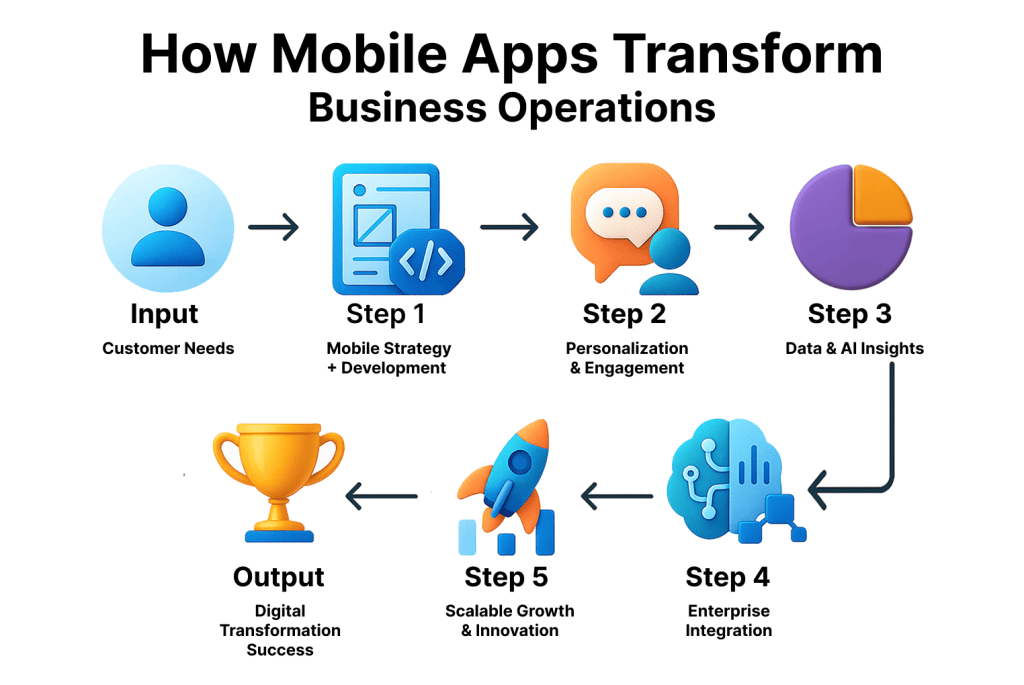
Ecommerce shows the effect most clearly. Shoppers on a phone want fast product pages, saved payment details and a checkout that takes a few taps instead of long forms. One-click checkout, secure payment gateways and personalized product feeds remove friction at each step.
The cost of getting this wrong varies by market and category, but slow or clumsy mobile checkout is a common reason carts are abandoned. Retailers that build the store and the app as one plan, rather than two separate projects, tend to see more repeat purchases and stronger loyalty.
When scoping the work, mobile app development services that cover payments, catalog sync and order tracking together are usually easier to maintain than a patchwork of separate vendors.
5. Driving Smarter Decisions with Data Driven Mobile Apps
Every tap, search and purchase inside an app creates data. The value comes from what you do with it. Real-time dashboards let managers watch sales, usage and support issues as they develop, and predictive models can flag a drop in repeat orders before it shows up in revenue.
Most of this runs on cloud infrastructure, so choices around storage, APIs and analytics pipelines in cloud-based app development shape how quickly insight reaches decision makers. AI features such as recommendations or demand forecasting sit on top of that foundation, which is why they work best when the data layer is planned from the start rather than bolted on later.
One caution: a dashboard is only useful if someone owns the decisions it is meant to inform.
6. Mobile Apps in Digital Transformation of Enterprise Systems
Enterprises increasingly treat apps as the front door to their systems. Sales reps open customer records before a meeting, managers approve budgets from a phone, and project updates reach leadership without waiting for a desktop session. In large organizations, small delays compound, so this speed has real operational value.
CRM mobile app development is a clear example. When client notes, deal stages and follow-up reminders are updated on the go, data stays current and customers get quicker responses. The catch is adoption: if the app is slower than the old process, people quietly return to spreadsheets.
Organizations extending this across CRM, ERP, HR and supply chain tools often rely on enterprise app development services to keep access rules, data models and user experience consistent across those systems.
7. Innovation Beyond Websites: Bridging Mobile and Web Together
None of this is an argument for replacing the website. Customers often start on a website and finish in an app, or the reverse, and the experience has to hold together. An ecommerce brand might announce an offer on its site, then send an in-app notification to shoppers who left items in a cart.
Consistency matters more than feature parity. Branding, login, product data and pricing should match across both channels, while each does what it does best: the website for discovery and search traffic, the app for repeat use and notifications. Sharing backend services between them also lets new features launch on either platform without breaking the other.
8. Security and Scalability as Mobile Priorities
Two concerns surface in almost every transformation project. The first is security. Users expect their data to be protected, and a breach can damage trust far more than any feature can build it. Strong authentication, encrypted transactions, secure API design and compliance with applicable data-protection rules are baseline requirements, along with regular updates and monitoring.
The second is scale. An app that works for 500 users can struggle at 50,000 if the backend, caching and database were not designed for growth. Mobile app performance optimization covers load times, battery use, crash rates and API response, and it is worth budgeting for before launch, not after the first wave of bad reviews.
9. The Future of Platforms: Android and Beyond
Platform choice affects both reach and budget. Android has the largest share of smartphones worldwide, and in India it dominates, so it is often the first platform for businesses targeting a broad audience. iOS still matters where customers skew toward higher spending, or where an enterprise standardizes on Apple devices. Cross-platform frameworks with a single codebase can cut cost and delivery time, though features tied closely to a specific device may still need native work.
Looking ahead, 5G, AI and IoT are expanding what apps can do, from faster connectivity to on-device intelligence and links with connected devices. Tracking mobile app development trends helps you judge which of these are worth adopting now and which can wait. Not every emerging feature belongs in a first release.

10. Why Mobile Apps in Digital Transformation Cannot Be Ignored
Organizations that treat mobility as a priority tend to see stronger engagement, better efficiency and new growth options, while those that wait often find faster competitors setting customer expectations. The goal, though, is not a single app. It is a connected ecosystem where mobile, web and back-end systems share data and behave consistently.
Start small. Pick one process or customer journey with a clear pain point, measure it, then expand. For businesses in Tamil Nadu, working with a mobile app development company in Chennai means a team in your time zone that understands local users and compliance needs. Whoever you choose, ask how they handle security, integration and post-launch support, because those decide whether the investment lasts.
Frequently Asked Questions
1. Do small businesses need a mobile app for digital transformation?
Not always. If your customers mainly find you through search and your processes are simple, a responsive website or web app may deliver more value for less. An app makes sense when you need repeat engagement, notifications, offline use or device features like the camera and location.
2. Should we build an app or improve the website first?
Fix the website first if it is slow, hard to use on mobile, or converts poorly, since the app will inherit the same problems. Build the app when you have a clear reason a native experience would do better, such as frequent repeat use or field operations.
3. Should we choose native, cross-platform or a progressive web app?
It depends on the use case. Native gives the best performance and device access. Cross-platform lowers cost and speeds delivery for most business apps. A progressive web app suits lightweight, content-led tools with no heavy device features.
4. What affects the cost of building a business mobile app?
Scope drives most of it: number of features, platforms, backend and integration work, security requirements and design complexity. Ongoing costs such as hosting, updates, testing and support also count, so budget for the full lifecycle, not just the first release.
5. How do you measure whether a mobile app is delivering results?
Tie metrics to the goal you set. Typical ones include adoption rate, retention, task completion time, error rates, support tickets, and revenue per user. Compare them against the process the app replaced, not against zero.
6. Why do mobile transformation projects fail?
Common causes are vague goals, poor integration with existing systems, low employee adoption, and no budget for maintenance after launch. Projects that start with one defined problem and a clear owner tend to avoid most of these.
7. How long does it take to build a business mobile app?
It varies with scope. A focused first version can often be ready in a few months, while apps with complex enterprise integrations, compliance needs or many user roles take longer. Releasing in phases usually reduces risk.