


Key takeaways
- Custom website development gives businesses greater flexibility, scalability, and control than template-based websites.
- Custom websites can deliver better performance, SEO, security, and user experiences tailored to business needs.
- A custom-built website can integrate with CRMs, APIs, payment gateways, analytics tools, and other business systems.
- Custom development makes it easier to adapt your website as your business, customers, and digital strategy evolve.
- Although custom websites require a higher upfront investment, they can provide stronger long-term value and support business growth.
If you’re building a business website, you’ve probably asked this question:
“Should I go with a template or invest in custom website development?”
At first glance, a ready-made template might seem like the faster and cheaper option. But here’s the truth, What works for a hobby site or personal blog doesn’t always work for a growing business.
In today’s competitive digital world, your website isn’t just an online brochure. It’s your brand’s first impression, your sales machine, and your customer’s gateway to everything you offer. That’s where our approach to custom website development makes a real difference.
This blog will break down:
- Why template-based sites can hold your business back
- How custom development unlocks scalability and performance
- What benefits you gain when your website is built specifically for your brand
If you’ve been searching for clear answers to “Is a custom website better for business?”, this guide is for you.
Why Templates Fall Short for Growing Businesses
You’ve seen them everywhere on website templates that promise quick results with just a few clicks. While they may work for small personal projects, they often fail to meet the demands of a growing business.
Are website templates bad for business growth?
They’re not bad, but they’re often not enough. Here’s why:
1. Limited Customization
Templates are built for mass use. As a result, your site could end up looking just like hundreds of others. As your business expands, you’ll quickly find yourself restricted by layout limits and functionality caps that don’t evolve with your goals.
2. Poor SEO Structure
Most templates are not coded with advanced search engine optimization practices in mind. They often have bloated code, slow loading times, and limited schema support, all of which hurt your visibility in search results.
3. Lack of Flexibility
If you need to integrate third-party tools, create a custom checkout flow, or add new features, a template can become a technical headache. These platforms aren’t built for deep customization or scaling.
4. Weakened User Experience
Many templates focus on design over functionality. Without optimization for different devices and user flows, you risk losing potential customers to slow load speeds or poor navigation.
5. Outdated Design Trends
Template designs can become outdated quickly. And unless the platform regularly updates them (which many don’t), your site might feel stale or unprofessional over time.
In short, templates can slow you down when you’re trying to grow. That’s why more brands are turning to custom website development for scalable, secure, and strategic solutions.
What Is Custom Website Development — And How Does It Work?
Custom website development is the process of building a website from the ground up designed specifically for your business, your customers, and your goals. Unlike templates, which offer pre-made layouts and fixed functionalities, Unlike templates, custom development gives you full control over every element of your website.
How does custom website development work for a business?
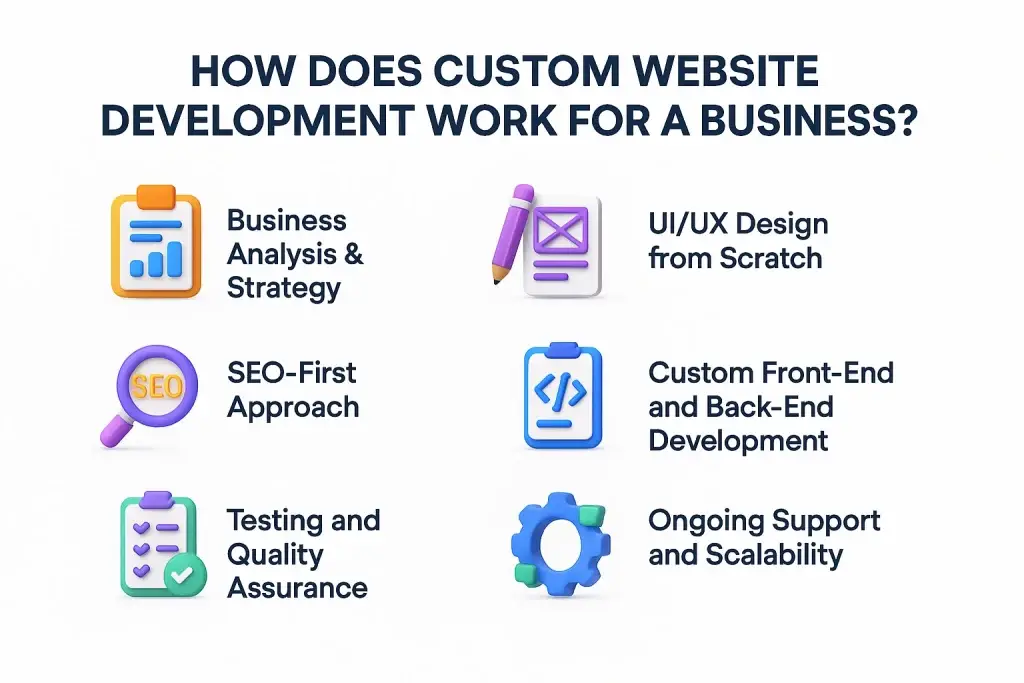
It starts with a discovery phase. Here’s what the process typically includes:
1. Business Analysis & Strategy
A web development team first learns about your business, target audience, and objectives. This ensures that the final product aligns with your brand and supports your long-term growth.
2. UI/UX Design from Scratch
Designers create a visual experience that reflects your identity not someone else’s. This includes brand colors, user journeys, mobile responsiveness, and intuitive navigation, tailored for your audience.
3. Custom Front-End and Back-End Development
Developers build the front-end (what users see) and the back-end (the logic and database that run your site). You can integrate CRM tools, APIs, eCommerce features, and more without limitations.
4. SEO-First Approach
Every line of code is written to improve page speed, security, and search engine visibility. Unlike templates, custom websites are optimized from day one for Google, voice search, and future scalability.
5. Testing and Quality Assurance
Your site is tested across all browsers, screen sizes, and devices. Bugs are resolved before launch. And ensuring a smooth and professional experience for users.
6. Ongoing Support and Scalability
A custom built site isn’t just a one time project. You can update features, add content, or pivot strategies anytime without breaking your design or structure.
With custom website development, your digital presence becomes a powerful business tool not just a static page online.
Key Benefits of Custom Website Development
If you’re aiming to stand out online and convert visitors into loyal customers, custom website development offers unmatched advantages. It’s not just about a fresh design, it’s about building a site that performs, scales, and supports your business goals.
What are the benefits of custom website development?
Here’s what sets a custom-built website apart:
1. Unique Brand Identity
Your website should reflect your brand, not a template used by dozens of other businesses. Custom development allows for a one-of-a-kind look and feel that matches your brand voice, color scheme, and customer experience.
2. Better Performance and Speed
Templates often come with unnecessary code and plugins that slow down performance. In contrast, custom websites are streamlined, meaning they load faster and work more efficiently across devices, both key ranking factors for Google.
3. SEO Optimization from the Start
Custom websites are built with SEO in mind from the foundation. From clean code to structured data, your site is equipped to rank higher in search results and even show up in voice search queries.
4. Enhanced Security
With custom development, you control the tools, hosting, and access. This makes it easier to implement strong security features and avoid vulnerabilities common in off-the-shelf templates.
5. Tailored User Experience
Everything from the navigation to the checkout process can be designed to fit your customer’s behavior. A smoother journey means higher conversions and better user satisfaction.
6. Scalability for Business Growth
Need to add new features as you grow like multi-language support, advanced analytics, or eCommerce website development capabilities? Custom sites scale with your business without the need for full redesigns.
When you invest in custom website development, you’re not just building a website. You’re creating a long-term digital asset that works for your brand 24/7.
How Custom Web Development Supports Your Business Goals
A well-designed website isn’t just about aesthetics. It’s a powerful business tool that can drive conversions, build trust, and support long-term growth. With custom website development, your online presence is designed to move in step with your strategy, not hold it back.
Why do growing brands need custom website design?
Because your business goals are unique, and your website should be too. Here’s how custom web development helps:
1. Aligns with Your Sales Funnel
From landing pages to contact forms, a custom site is built to guide users through your specific buyer journey. Whether you’re focused on lead generation, bookings, or product sales, every element is created to support conversions.
2. Integrates with Business Systems
Unlike templates, custom websites can be seamlessly connected to your existing tools like CRMs, inventory systems, analytics platforms, and marketing automation. This improves efficiency and keeps your business data synchronized.
3. Builds Long-Term Credibility
First impressions matter. A custom design that reflects your professionalism and reliability increases trust. And trust directly impacts buying decisions, especially online.
4. Adapts to Changing Needs
Your business will evolve, new products, services, or even a rebrand. A custom-built website is easier to update and adapt without needing to start from scratch or work around fixed template limitations.
5. Supports Multi Channel Strategy
Need landing pages for ad campaigns? SEO-friendly blog structures? Social media integration? A custom site is flexible enough to support every aspect of your digital marketing strategy.
In short, a custom developed website acts as a strategic asset and not just a digital placeholder. It empowers your team, supports your growth, and adapts to future opportunities.
Comparing Costs: Is Custom Website Development Worth the Investment?
When deciding between a template and custom website development, cost is often the biggest concern. Templates seem budget-friendly upfront, but the long-term value of a custom-built site often outweighs the initial savings.
Is custom web development expensive?
Yes, a custom website does cost more initially. But like any smart investment, it delivers far more in return over time. Let’s break it down:
1. Upfront vs. Ongoing Costs
- Template Site: You may pay a small fee for the theme and hosting, but you’ll likely spend more later fixing limitations, hiring developers to add features, or redesigning when your business grows.
- Custom Site: You pay more upfront for strategy, design, and development. However, your site is built to scale, saving you time, money, and frustration in the long run.
2. Return on Investment (ROI)
A custom site is designed to:
- Convert more visitors
- Rank higher in search results
- Load faster and perform better across devices
These improvements directly impact your revenue and customer satisfaction, making the investment worthwhile.
3. Fewer Hidden Costs
Templates often require additional plugins and third-party tools to fill gaps. Which can come with monthly fees, compatibility issues, or security risks. Custom websites are built with everything you need, already integrated.
4. Avoiding Redesigns
Businesses often outgrow their template websites within a year or two. A custom site, however, is made to evolve. That means fewer overhauls and more focus on growing your brand.
5. Competitive Advantage
When your website is custom-made for your audience and goals, it gives you an edge over competitors using cookie-cutter designs. That competitive advantage has long-term value.
In short, while custom website development requires a larger investment upfront, it pays off through better performance, fewer limitations, and higher returns over time.
Choosing the Right Web Development Services for Your Business
Investing in custom website development is a smart move, but only if it’s done right. Choosing the right custom website development company is just as important as the decision to go custom. The right partner will understand your business goals, user behavior, and technical requirements to deliver a solution that performs beyond just looking good.
Here are key factors that define a reliable and expert partner:
1. Experience with Business Website Design
Not all developers understand business needs. Choose a team that focuses on converting visitors into customers, not just building attractive layouts. Look at their previous work, especially with companies in your industry.
2. Transparent Process and Communication
Your development team should walk you through every step, from strategy and design to launch and support. Clear timelines, scope, and regular updates are signs of a professional service.
3. SEO and Mobile Expertise
A good web development service will prioritize search engine optimization and responsive design. Ask how they handle:
- Page speed optimization
- Schema markup
- Mobile usability
- Core Web Vitals
4. Custom Features and Integrations
Whether you need payment gateways, booking tools, or CRM integrations, the developer should be able to build features that fit your workflow, not force you to work around limitations.
5. Post Launch Support and Scalability
Your website shouldn’t be “done” at launch. Look for a service that offers ongoing maintenance, performance tracking, and room to grow. A long-term partner helps your website evolve with your business.
6. Trust Signals
Choose a team with verified reviews, client testimonials, and a proven portfolio. Certifications, awards, or industry recognition are additional signs of credibility.
Partnering with the right web development company ensures that your custom business website is both beautiful and functional, tailored to your goals, and ready to deliver measurable results.

Conclusion
If you want your website to be more than just a digital placeholder. If you want it to attract, engage, and convert visitors, then custom website development is the smarter choice.
Templates may offer a quick fix, but they rarely support long-term business growth. On the other hand, a custom-built site is:
- Uniquely designed to reflect your brand
- Structured for performance and SEO
- Built to scale with your business
- Optimized for both human users and search engines
In a world where your online presence can make or break a sale, a custom website isn’t just a luxury it’s a strategic business asset.
FAQs
1. Is a custom website better than a template website?
A custom website is generally better for businesses that need flexibility, scalability, stronger performance, and features tailored to their customers. Templates can work for simple websites, but they may become restrictive as a business grows.
2. How much does custom website development cost?
The cost of custom website development depends on factors such as the website’s complexity, number of pages, integrations, functionality, technology stack, and ongoing support requirements. While the initial investment is usually higher than a template, custom development can provide greater long-term value.
3. How long does it take to build a custom business website?
A custom business website can take anywhere from several weeks to several months, depending on its scope. The process typically includes strategy, UI/UX design, development, integrations, testing, SEO implementation, and launch.
4. Can a custom website improve SEO?
Yes. A custom website can be developed with SEO considerations from the beginning, including clean code, optimized page speed, responsive design, structured data, crawlable architecture, and technical SEO foundations.
5. Can a custom website scale as my business grows?
Yes. One of the major advantages of custom website development is scalability. New features, integrations, landing pages, languages, eCommerce functionality, and other capabilities can be added as business requirements evolve.
6. Are custom websites more secure than template websites?
Custom websites can provide greater control over security because developers can select the technology stack, hosting environment, integrations, access controls, and security measures. However, security ultimately depends on how the website is developed, configured, maintained, and updated.
7. When should a business choose a custom website instead of a template?
A business should consider custom development when it needs unique functionality, advanced integrations, specific user journeys, scalability, stronger performance, or a website closely aligned with its brand and business goals.
8. Is custom website development worth the investment?
For businesses that depend heavily on their website for leads, sales, customer engagement, or digital growth, custom website development can be worthwhile because it provides greater control, flexibility, scalability, and opportunities for optimization than a basic template site.