
Loading...

Aviation businesses need digital experiences connecting passengers, flight ops, and airport teams. Code Neptune builds applications that simplify passenger journeys, improve operational visibility, and support scalable airline and airport workflows.






Connect passengers, airline teams, airport operations, crew, and enterprise systems through purpose-built digital platforms.

Mobile check-in, boarding passes, flight status, notifications, loyalty, and travel assistance.

Flight coordination, crew workflows, operational visibility, and internal communication.

Ground operations, baggage workflows, gate information, staff mobility, and service coordination.

Mobile applications, dashboards, APIs, cloud infrastructure, analytics, and enterprise integrations.
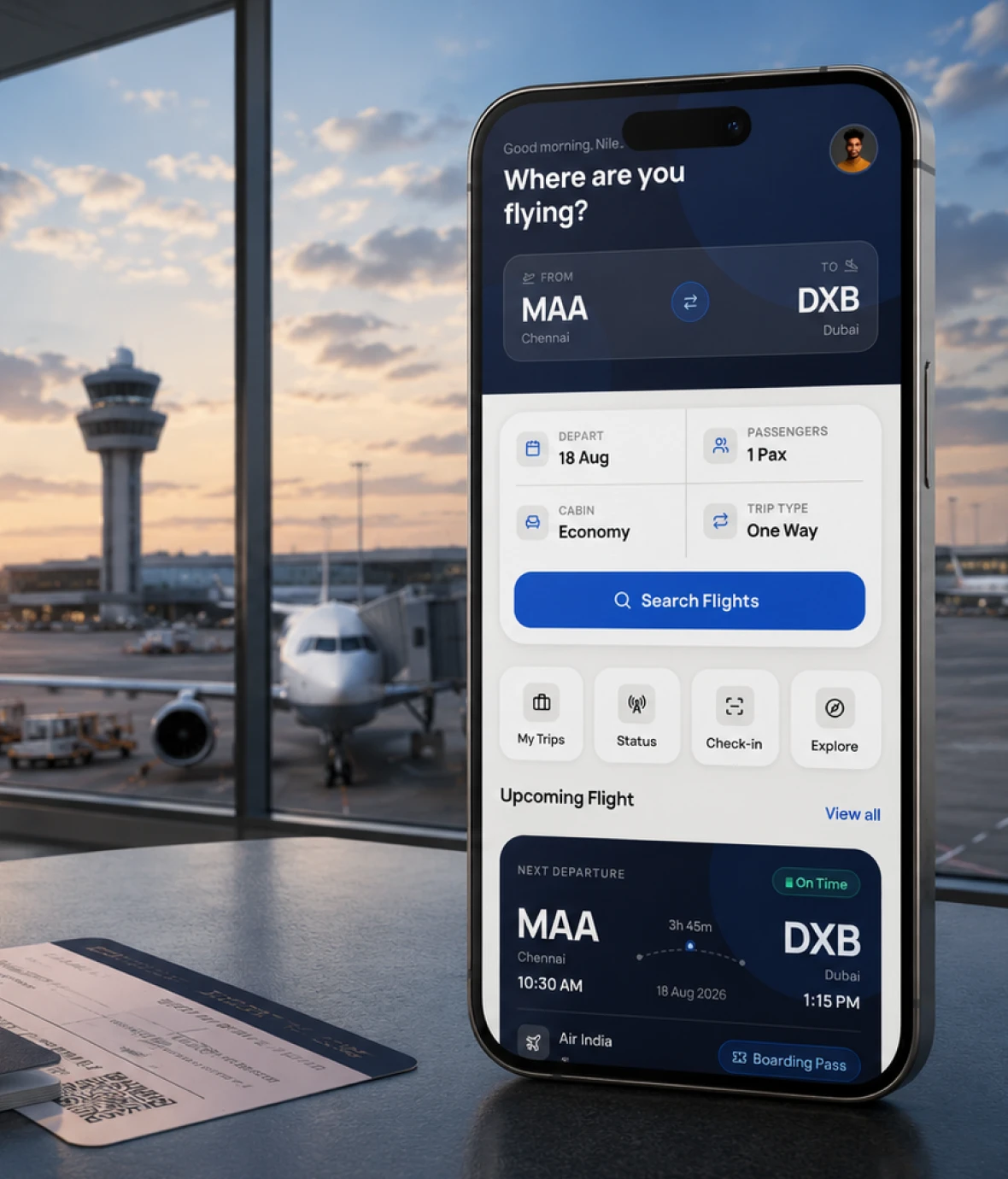
Aviation software often operates as part of a wider technology ecosystem. Mobile applications may need to connect with booking systems, airport platforms, airline operations, enterprise software, APIs, payment services, and operational dashboards.

Understand passenger journeys, flight operations, airport workflows, crew requirements, ground handling processes, and business objectives before defining the product scope.
Develop tailored applications for passengers, airline employees, airport teams, crew, ground staff, and aviation businesses around their specific workflows.
Build connected enterprise applications for airline operations, airport management, crew workflows, administration, reporting, and multi-system coordination.
Select native or cross-platform development according to passenger requirements, device coverage, performance expectations, operational environments, and long-term maintenance considerations.
Connect aviation applications with booking platforms, flight systems, airport services, payment platforms, identity services, notifications, enterprise software, and approved third-party APIs.
Modernize legacy aviation software, improve passenger and employee experiences, strengthen integrations, optimize performance, and continue evolving the platform after deployment.
Aviation applications need to support highly connected workflows. Passenger-facing experiences may operate alongside flight operations, airport systems, crew applications, baggage services, and enterprise platforms.
Mobile check-in, boarding passes, flight information, booking access, notifications, loyalty, and travel assistance.

Support airport teams with operational workflows, staff mobility, gate coordination, and service visibility.

Flight schedules, operational updates, crew coordination, flight status, and internal workflows.

Track baggage workflows, status updates, notifications, and operational coordination.

Support crew schedules, assignments, notifications, operational communication, and workforce mobility.

Coordinate ground staff, aircraft turnaround activities, task allocation, inspections, and operational reporting.

Support maintenance workflows, inspection records, service schedules, equipment information, and reporting.

Provide operational dashboards, passenger insights, performance reporting, and management visibility.

Discuss your passenger journey, operational workflows, integrations, security requirements, and long-term aviation technology goals before development begins.

Aviation applications may connect passenger information, operational records, employee workflows, payments, and enterprise systems. Architecture should therefore account for appropriate access controls, data protection, system reliability, and operational traceability.
Apply appropriate data handling, access controls, privacy considerations, and retention practices according to the application's scope and applicable requirements.
Separate access between passengers, crew, airport staff, administrators, operations teams, and other authorized users through controlled permissions.
Use appropriate logging, activity tracking, workflow records, and system monitoring to improve visibility across aviation operations.
Aviation compliance requirements should be mapped to the actual application, jurisdiction, integrations, data, and operational environment rather than treated as a generic checklist.
Separate access for passengers, crew, ground teams, airport employees, administrators, and aviation operations personnel.
Protect passenger and employee accounts with authentication workflows appropriate to the application and its operational requirements.
Protect passenger information, booking details, operational records, documents, and other sensitive data through appropriate application and infrastructure controls.
Protect communication between mobile applications, airline systems, airport platforms, payment services, databases, and third-party APIs.
Track important system activities, service health, workflow events, and application performance to support reliable aviation operations.
Optimize application responsiveness, resource usage, API communication, and real-world performance across passenger and operational devices.
Use controlled access, monitoring, protected services, backups, and scalable infrastructure for applications supporting aviation operations.

Aviation applications require careful planning around passengers, operations, integrations, security, performance, and multiple user groups. The development process should validate these requirements before the product moves into deployment.
Understand passenger journeys, flight operations, airport processes, crew requirements, ground activities, and project objectives.
Prioritize essential workflows, define the product scope, establish technical requirements, and create a practical development roadmap.
Design clear experiences for passengers, crew, airport teams, and administrators while considering usability, accessibility, device conditions, and operational environments.
Develop mobile applications, backend services, APIs, dashboards, integrations, and supporting platform components according to the approved architecture.
Validate workflows, integrations, device compatibility, security, reliability, and performance under realistic operating conditions.
Prepare the application for deployment and connect it with approved airline, airport, enterprise, payment, notification, and operational systems.
Monitor application performance, incorporate operational feedback, strengthen security, and expand capabilities as aviation requirements evolve.

Start With the Operational Workflow. Description: Bring your passenger experience, aviation workflow, technical requirements, integrations, and long-term platform goals to a structured product discussion.
Manage flight information, check-in, boarding, baggage, crew workflows, ground operations, maintenance activities, notifications, and service processes.
The cost of aviation app development depends on passenger workflows, operational complexity, integrations, platform requirements, security, real-time capabilities, enterprise systems, and long-term scalability.
3–5 months
Suitable for a focused passenger service, aviation startup product, or initial operational application.
For aviation platforms requiring specialized workflows, real-time systems, enterprise integrations, security requirements, or phased development.
timelines are presented as planning ranges, not fixed promises, as the actual delivery schedule follows discovery and technical scope. Keep this framing intact in the CMS; don't let editors round these into guaranteed dates.
The technology stack should be selected according to the application's passenger and operational requirements, device coverage, performance expectations, integrations, security needs, and long-term maintenance strategy. .
Evaluate whether the team can understand passenger journeys, airport operations, flight workflows, crew mobility, and aviation-specific requirements.
Look for experience creating reliable mobile experiences across passenger, employee, and operational use cases.
Assess experience connecting applications with enterprise systems, APIs, databases, identity services, payment systems, and operational platforms.
The development partner should demonstrate structured practices around authentication, access control, API protection, data security, and monitoring.
Aviation applications may require live flight information, notifications, status updates, tracking, and time-sensitive operational communication.
The platform should support growing passenger volumes, additional airports, more operational users, new integrations, and future services.
Aviation platforms require ongoing maintenance, performance improvements, security updates, integration changes, and product evolution.
Clarify ownership, documentation, deployment access, technical handover, and long-term control of the developed platform.
Be cautious of providers that offer generic mobile applications without understanding aviation operations, real-time requirements, enterprise integrations, security, passenger experience, or long-term platform scalability.
Got Questions ?
We have the answers. Explore everything you need to know about Code Neptune’s services, process, and technology.
An Aviation App Development Company can build airline passenger applications, airport management platforms, flight operations applications, baggage systems, crew applications, ground handling solutions, maintenance platforms, and aviation analytics products.
Yes. Aviation applications can be developed for iOS and Android using native or cross-platform approaches. The appropriate option depends on performance, device coverage, integrations, and long-term maintenance requirements.
AI can support appropriate aviation use cases such as passenger assistance, flight information support, predictive maintenance, delay forecasting, personalization, operational analytics, and workflow automation.
A focused aviation application may require several months, while larger airline or airport platforms with multiple workflows and integrations can require substantially more time. The actual timeline should follow technical discovery and scope.
The cost depends on application complexity, passenger and operational workflows, integrations, platforms, real-time capabilities, security requirements, and infrastructure. A discovery process can establish the scope before estimating the investment.
Yes. Applications can integrate with approved airline, airport, booking, payment, identity, notification, enterprise, and operational systems through available APIs and integration mechanisms.
Yes. Airport applications can support staff mobility, gate operations, baggage workflows, ground handling, passenger services, inspections, notifications, and operational reporting.
Yes. Existing aviation platforms can be modernized through improved mobile experiences, API integration, cloud infrastructure, security improvements, performance optimization, and phased product development.
Build tailored airline, airport, and crew apps aligned with your workflows, integrations, security, and growth plan.
01
Let us know everything you want to achieve!
02
A quick, no-pressure call to understand your needs.
03
Enjoy transparent pricing with potential discounts!
Enquiry
Careers
+91 98416 00980Visit
No. 624, 3rd Floor – S2, Khivraj Building, Anna Salai, Chennai – 600 006


No. 624, 3rd Floor – S2, Khivraj Building, Anna Salai, Chennai – 600 006
Jobs :
careers@codeneptune.comEnquiry :
info@codeneptune.com